
Blog
How to Avoid Unnecessary Car Repairs

Last Updated: November 3, 2026
Quick Summary
You avoid unnecessary car repairs by following your owner’s manual maintenance schedule and asking the shop to show the worn part, photo, or measured test result behind each recommendation. Request an itemized estimate and ask what happens if you wait 30 days or 1,000 miles before approving work.
- 46% of surveyed drivers said they paid for a repair they believed better maintenance could have avoided.
- If a shop recommends a transmission flush but your manual says inspect only, ask why.
- A brake pad at 2 mm will likely reach the wear indicator within a few hundred miles of city driving.
- Get a second opinion when the estimate is large, the diagnosis is vague, or it does not match your schedule.
- Deferrable items should get a date or mileage trigger, such as rechecking brake pad thickness at the next oil change.
Table of Contents
- Why Unnecessary Car Repairs Happen and How to Spot One
- Follow Your Car Maintenance Schedule by Mileage
- Questions to Ask a Mechanic Before Repairs Begin
- How to Compare Car Repair Estimates Line by Line
- When to Get a Second Opinion on Car Repairs
- Separating Safety-Critical Repairs From Deferrable Work
- How Local Driving Conditions in Powder Springs Affect Your Maintenance
- Book a Transparent Inspection at Powder Spring BLT
- Frequently Asked Questions
Why Unnecessary Car Repairs Happen and How to Spot One
Unnecessary car repairs are services a shop recommends that your car does not actually need right now, or services priced far above what the job requires. According to Motor’s report on drivers putting off maintenance, 46% of surveyed drivers said they had paid for a repair in the past that they believed could have been avoided with better maintenance.
That number cuts two ways. Some of those bills came from skipped oil changes and worn brakes. Others came from a shop selling work that was never needed in the first place.
Here is what most guides get wrong: they tell you to “find a trustworthy mechanic” and stop there. That is not a plan. You need a way to check the recommendation yourself.
Below, we’ll show you exactly how to spot an unnecessary repair, question it, and compare estimates line by line. The steps work whether you use our shop or anyone else’s.
A quick way to spot an unnecessary repair:
- The shop cannot show you the worn part or a photo of it
- The estimate lists a “flush” your owner’s manual never mentions
- The price appears before anyone has run a diagnostic check
Follow Your Car Maintenance Schedule by Mileage
Your car maintenance schedule by mileage is the single best defense against unnecessary car repairs. It tells you what your car needs and when, so you can spot a recommendation that does not fit.
What the Owner’s Manual Actually Tells You
Your owner’s manual lists the service interval for every fluid, filter, and belt on your car. Follow it. Consumer Reports’ car maintenance guide flags some services as potentially unnecessary and advises sticking to the owner’s-manual recommendations for oils and fluids, especially flushes and pricier fluid types.
That is the key point. If a shop recommends a transmission flush and your manual says “inspect only,” ask why.
Mileage Milestones That Matter Most
Most cars follow a similar rhythm. Exact numbers vary by model, so check your manual first.
| Mileage | What to Check | Why It Matters |
|---|---|---|
| Every 5,000-7,500 | Oil and oil filter change | Prevents engine wear |
| Every 15,000 | Air filter, tire rotation | Fuel economy, even tire wear |
| Every 30,000 | Brake inspection, coolant check | Safety and overheating |
| Every 60,000 | Belts, hoses, transmission fluid | Avoids roadside breakdowns |
| Every 90,000+ | Timing belt if equipped, full inspection | Prevents major repairs |
For commuters who drive daily, we put together a deeper preventative maintenance guide for daily commuters that maps these intervals to real driving habits.
Questions to Ask a Mechanic Before Repairs Begin
The right questions before repairs begin turn a one-sided sales pitch into a conversation. Ask them before you approve anything, not after. The goal is not to interrogate the shop, it is to get evidence you can evaluate yourself.
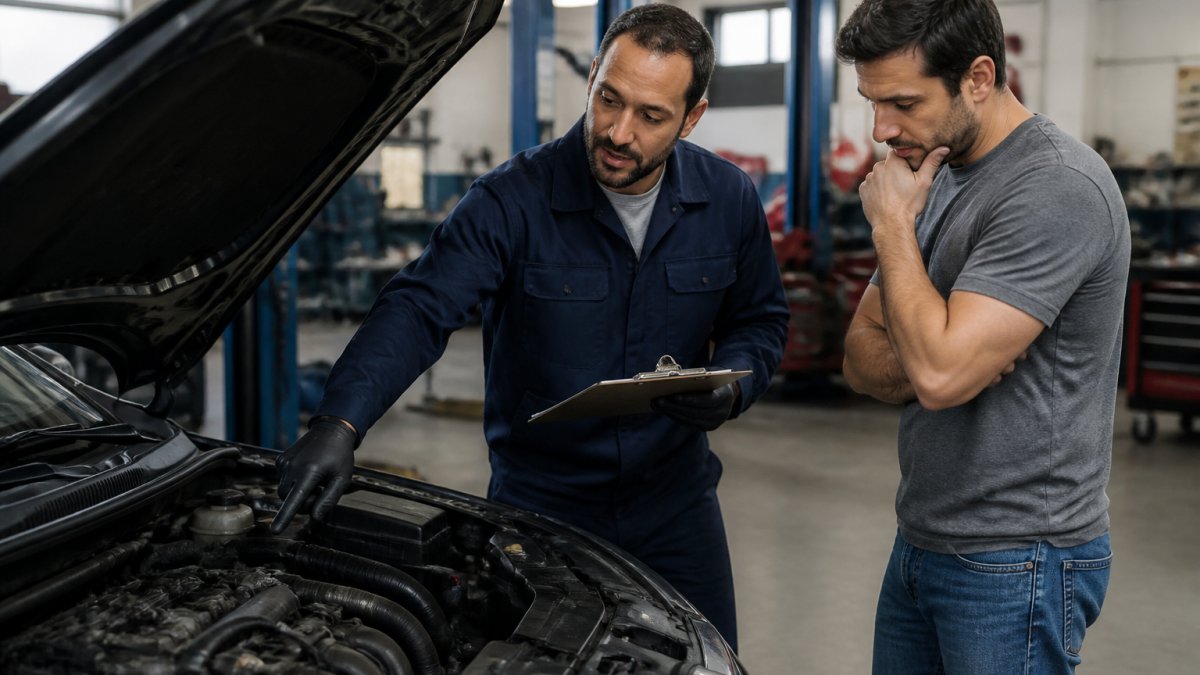
A repeatable verification process has four steps: request the evidence, ask about urgency, compare the estimate line by line, and seek a second opinion when the stakes justify it. Here is how each step works in practice.
Step 1: Request the Diagnosis and the Evidence
Ask the shop to show you the worn part, a photo of it, or the measured test result that triggered the recommendation. For brakes, that means pad thickness in millimeters or a rotor measurement.
Bring this list with you:
- Can you show me the worn part or a photo of it?
- What measurement or test result led to this recommendation?
- What happens if I wait on this repair?
- Is this safety-critical or can it wait?
- What diagnostic trouble code led you here, and what test confirmed the cause?
- Is this price for parts and labor, itemized?
- What does your service guarantee cover?
Watch out: a shop that answers question one with “we already put it back together” or “the tech saw it on the rack” is asking you to trust a conclusion without evidence.
Step 2: Ask About Urgency in Concrete Terms
“Is this urgent?” invites a yes. “What happens if I wait 30 days or 1,000 miles?” invites a mechanism. A good answer names a consequence and a timeframe: a brake pad at 2 mm will likely reach the wear indicator within a few hundred miles of city driving; a seeping valve cover gasket may never need attention during your ownership.
Step 3: Compare the Estimate Line by Line
Ask for an itemized estimate before any work begins. The estimate should separate parts, labor, and diagnostic fees, and it should list a brand or part number for each part. “Brake pads” is not a quote; “ceramic front pads, part #XYZ” is. Labor should show both the hourly rate and the estimated hours. Ask whether the diagnostic fee is applied toward the repair if you approve the work.
Step 4: Decide Whether a Second Opinion Is Worth It
A second opinion is most valuable when the estimate is large, the diagnosis is vague, or the recommendation does not match your maintenance schedule. It is least valuable when the problem is obvious and safety-critical, a leaking brake line or a visibly bald tire does not need a second look before you act.
We also suggest asking how the shop handles guarantees before you commit. Our guide on how to judge an auto repair shop’s service guarantee walks through what to look for.
How to Compare Car Repair Estimates Line by Line
Comparing car repair estimates means reading three things on each quote: parts, labor, and fees. Most overcharges hide in one of those three lines.
Parts, Labor, and Diagnostic Fees Explained
Parts should list a brand or part number. “Brake pads” is not a quote. “Ceramic front pads, part #XYZ” is.
Labor is usually charged by the hour at a posted rate. Ask for the rate and the estimated hours.
Diagnostic fees cover the time to find the problem. A fair shop applies that fee toward the repair if you go ahead.
Use this checklist when you compare:
- Every part has a name or number
- Labor hours and hourly rate are both listed
- Diagnostic fee is stated up front
If you want to see what transparent pricing looks like in practice, our guide on auto repair shops with transparent pricing breaks it down. You can also check average car repair costs in Powder Springs to judge whether a quote is in a normal range.
When to Get a Second Opinion on Car Repairs
Get a second opinion on car repairs when the estimate is large, the diagnosis is vague, or the recommendation does not match your maintenance schedule.
Signs you should get one:
- The bill is well above what you expected
- The shop cannot show you the problem
- The fix sounds like a guess
A second opinion is not an insult to the first shop.
One honest limit: a second opinion takes time. If a brake line is leaking or a wheel is about to fail, do not wait.
Separating Safety-Critical Repairs From Deferrable Work
Sort every recommendation into two piles: fix now, or plan for later. That one habit prevents most unnecessary car repairs and keeps you safe. The hard part is not the obvious cases, it is the borderline ones, where a shop’s urgency claim and your budget are pulling in different directions.
A useful urgency framework asks three questions about each recommendation: Does it affect steering, braking, tires, or visibility? Is there a measurable wear limit or test result that has already been crossed? And is there a known failure mode with a short timeline? If the answer to any of those is yes, treat it as safety-critical until a qualified technician shows you evidence otherwise.
Fix now (safety-critical):
- Brake pads worn past the manufacturer’s limit, or a soft or spongy brake pedal
- A leaking brake line, caliper, or wheel cylinder, or brake fluid that is losing level
- Bald tires, sidewall cracks, or a tire that cannot hold pressure
Can usually wait (deferrable), with a plan:
- A cabin air filter
- Minor cosmetic wear or a slow seeping gasket that is not losing measurable fluid
- A fluid flush your owner’s manual does not call for
When in doubt, ask: “What happens if I wait 30 days?” A shop that answers honestly earns your business. One that says “your car might explode” for a cabin filter does not.
Keep your records. A folder of service receipts and a note of the date and mileage of each deferred item helps you avoid paying twice for the same inspection and supports any warranty or resale conversation later.
How Local Driving Conditions in Powder Springs Affect Your Maintenance
Driving around Powder Springs puts specific wear on your car. Short trips, stop-and-go traffic on busy roads, and hot Georgia summers all shorten the life of certain parts.
What we see most in local cars:
- Brakes wear faster from constant stop-and-go driving
- Batteries fail sooner in summer heat
- Tires wear unevenly without regular rotation and alignment checks
If you are searching for a trustworthy shop near me in Powder Springs, ask how they adjust the maintenance schedule for local driving.
Book a Transparent Inspection at Powder Spring BLT
Working with a shop that explains the findings before quoting a fix helps avoid unnecessary car repairs.
Our certified mechanics use modern equipment and high-quality parts to run precise diagnostics. We aim to keep communication transparent and reliable.
If you are tired of guessing whether a repair is real, let us take a look. Get a quote and see exactly what your car needs, and what it does not.
Frequently Asked Questions
How can I tell if a mechanic is recommending a repair I don’t need?
Ask for the evidence behind the recommendation. A trustworthy shop will show you the worn part, explain the diagnostic trouble code, and connect the repair to a symptom you can feel or see. Cross-check the suggested work against your owner’s manual service interval. If a service appears nowhere in the manual and no one can show you physical proof of wear, ask why it is needed before you approve it. Consumer Reports notes that some flushes and premium fluids are pushed harder than the manual requires.
Should I get a second opinion on a car repair estimate?
Yes, when the estimate is large, the diagnosis is vague, or the shop recommends several repairs at once. A second opinion on car repairs is especially worth the time for transmission, engine, and electrical work. Bring the written estimate and ask the second shop to confirm the diagnosis rather than repeat the whole inspection. If both shops reach the same conclusion with visible evidence, the repair is likely genuine and you can move forward with confidence.
How does regular maintenance help prevent expensive car repairs?
Surveys of drivers suggest that many have paid for repairs they believe could have been avoided with better maintenance. Oil changes, fluid checks, brake inspections, and tire rotations catch wear before it turns into failure. Following the car maintenance schedule by mileage in your owner’s manual keeps small fixes small. Skipping intervals lets a worn belt become a broken engine, and a low fluid level become a burned-out transmission.
What should I do if a mechanic recommends several repairs at once?
Ask the shop to rank the list by safety and urgency. Brakes, steering, and tires come first; cosmetic or convenience items can wait. Request an itemized estimate showing parts, labor, and any diagnostic fee separately so you can compare car repair estimates fairly. If the list is long and the evidence is thin, get a second opinion before approving everything. Spreading deferred work across two visits is normal and often cheaper than rushing every job at once.
Your car should not cost you more than it has to. If a repair recommendation feels off, get it checked by a team that puts the evidence in front of you. Get started with Powder Spring BLT and drive away knowing every dollar went to a repair your car actually needed.
